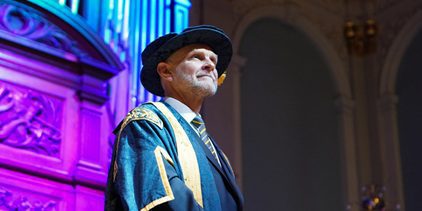
‘You are this university’: Professor Ashley Wheaton’s final farewell
Posted on: 29 October, 2026

By Linda Serck
As Professor Ashley Wheaton prepares to step down after 13 years, a series of events have provided an opportunity for Ashley to reflect on the decisions, challenges and people behind the University of the Built Environment’s transformation, while colleagues and alumni pay tribute to his leadership.
The night the University of the Built Environment celebrated its new name and status was also a moment of pride and reflection for the institution’s first Vice Chancellor.
In June 2025, colleagues, partners, alumni and friends gathered at London’s Barbican Conservatory for the official launch of the University of the Built Environment, formerly University College of Estate Management (UCEM).
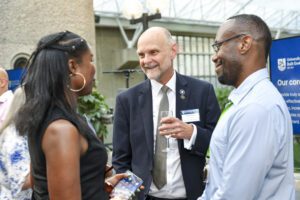
For Professor Ashley Wheaton, who had spent more than a decade working towards that moment, the celebrations brought a powerful sense of completion.
“That night felt very much like the pinnacle of achievement,” he recalled. “A fitting celebration of the 15 or so years which had led up to it.”
As the University looked to new beginnings, Ashley began to reflect on his own future, and now he is preparing to step down at the end of October 2026.
At his University farewell event, he told staff that he leaves with an unusual distinction: “I’ve had the unique privilege of being both the last principal of this institution and, of course, its first ever Vice Chancellor.”
‘Thousands of graduation handshakes’

His 13 years at the helm have changed the institution’s name, reach and standing. Yet in his farewell reflections, it is the people rather than the milestones who feature most prominently.
When asked what he will treasure, his thoughts turn to graduations rather than regulatory approvals.
“The moments that I will treasure the most are not the regulatory letters,” he told staff. “More important to me are the very many graduation ceremonies, and the literally thousands of handshakes and nervous smiles.”
Behind those handshakes were apprentices studying after long days at work, parents combining study with family responsibilities and professionals returning to education when they had thought the opportunity had passed.
“That’s what we enable, and that’s where our core purpose lives,” he said.

For alumna Annabel Huffer (pictured above), now a senior building surveyor at Knight Frank after completing her apprenticeship and graduating in 2023, Ashley’s personal interest in students made a lasting impression:
“What has always struck me is that, despite the University’s growth, he has never lost the ability to make people feel valued as individuals. Over the years, he has remembered not only me, but also my family, making us feel a distinct part of the university.”
As one colleague wrote in a farewell message, Ashley leaves “a wonderful legacy of a special institution, a fantastic team, and a genuine community”.
Ashley is equally insistent that the university’s achievements belong to its staff. He thanked colleagues across academic and professional services teams, estimating they had contributed some eight million working hours during his tenure.
“It happened because of the people,” he said. “You are this university.”
A decision that changed everything
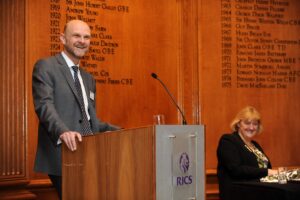
When Ashley joined the College of Estate Management on 1 November 2013, its future was far from assured. Finances were under pressure and the institution was seeking a sustainable, independent future. Three years earlier, its board had opted to pursue independence rather than become fully part of the University of Reading.
“Bravely, they chose independence,” Ashley said in his farewell address. “And every major milestone since has flowed from that original decision.”
Adam Marks, who chaired the nominations and governance committee involved in his appointment, remembers the challenge facing the incoming Principal.
“We considered it a huge responsibility and a daunting task knowing the challenges. However, we were all very excited when we were able to appoint such a dynamic and energetic leader in Ashley. Our main worry then was whether those challenges would keep Ashley sufficiently motivated to stick at the role for more than a few years. How unfounded those concerns proved to be!”
One of Ashley’s early priorities was to clarify the institution’s purpose, drawing on its Royal Charter: accessible, relevant and cost-effective education that enhanced careers, raised professional standards and contributed to a better built environment. That mission would underpin the changes to come.
In 2015, the College became University College of Estate Management, a landmark Ashley announced to staff at the time with evident pleasure: “I’m delighted to advise you that you now all work for a University College.”
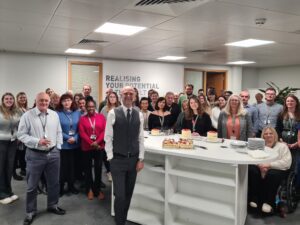
For Ashley, apprenticeships embodied the institution’s belief that higher education should be accessible to people already working in the sector. That practical approach mattered to students who could not put their careers or family responsibilities on hold to study.
He recalled one student who said: “I had offers from five top universities to study surveying but I chose UCEM because I wanted an apprenticeship.”
“Stories like that make the difficulties we encountered along the way all worthwhile,” Ashley said.
Its established experience in online learning also helped UCEM navigate the disruption of the Covid-19 pandemic. Alongside that came demanding regulatory work, including registration with the Office for Students and the renewal and eventual permanent award of degree-awarding powers.
Looking towards the next century

Our centenary in 2019 marked another turning point. A visit by the then Prince of Wales, now King Charles III, celebrated the institution’s history, while conversations about its future gathered momentum.
Ashley believed a university dedicated to the built environment should bring more disciplines together, from surveying and real estate to architecture, planning, construction and design.
His belief in collaboration extended beyond higher education. A relationship with The King’s Foundation developed into a partnership built around shared ambitions for the built environment.
“What began with a brief conversation became a partnership that delivered far more than either of us imagined,” said Ben Bolgar of The King’s Foundation. “Ashley has an ability to see connections and opportunities where others see separate challenges. He understood that improving the built environment depends on bringing together education, industry and public purpose, and he was relentless in turning that vision into reality.”
For an institution with roots in surveying and estate management, this meant looking beyond familiar subject boundaries. Ashley envisaged an education which prepared future architects, surveyors and construction professionals with an understanding of one another’s work before meeting on a project.
The merger with the London School of Architecture in June 2025 helped give that ambition shape. University status and its new name were the most visible signs of a transformation many years in the making.
An ‘incredible opportunity’

As he hands over to interim Vice Chancellor Jane Fawkes, he sees his role as one of stewardship.
“Nobody really owns a university,” he reflected. “You look after it for a while. You do your best, and you try to move it forwards.”
The College of Estate Management he joined in 2013 was fighting to secure an independent future. The University of the Built Environment he leaves has that independence, university status and a wider range of disciplines under one name.
“Thirteen years ago, I came here because of one thing, and that was what I saw as an incredible opportunity,” Ashley said.
Looking back, he concluded: “It feels like opportunity fully realised.”