
How Britain’s gaybourhoods shaped the modern city
Posted on: 12 June, 2026

Hurst Street, Birmingham
By Linda Serck
Today, places such as Soho, Canal Street and Kemptown are celebrated cultural LGBTQ+ landmarks. Yet their origins lie in a hidden geography of social exclusion, secrecy and anonymity. What can their story tell us about the cities we build today?
 In the public imagination, a ‘gaybourhood’ – or gay village – is often associated with colourful visibility and celebration: rainbow flags stretched across busy streets, bustling bars, and jubilant Pride festivals and parades.
Yet the origins of these gay neighbourhoods reside in a very different story: a story riddled with taboo, secrecy and anonymity; a story where identity was forged within a morally straight-jacketed society; and a story that unfolded while male homosexuality remained subject to legal and social punishment until the late 1960s.
As a result, areas such as Soho in London, Canal Street in Manchester and Kemptown in Brighton were originally places of refuge, connection and belonging for marginalised, counter-culture communities. They were built environment spaces neglected by the mainstream or with a reputation for inhabiting the fringes of society long before they became recognised cultural destinations or gentrified spaces.
Taking in this history and evolution, gay villages reflect not only changing attitudes towards LGBTQ+ rights but also highlight how cities are shaped by social pressures and the ways communities adapt the built environment to meet their needs.
Gaybourhoods: identity and place
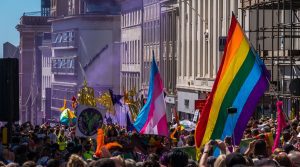
Pride festival, Brighton
For urban planners, gaybourhoods offer a particularly valuable lens through which to understand the relationship between identity and place. As we’ve established, these are not areas overtly shaped by formal urban planning policies and design, but have developed organically through a combination of social exclusion, economic circumstances and community action.
Charlotte Morphet, lecturer in Urban Planning at the University of the Built Environment, said there are some sharp lessons to be learnt about these areas: “Gaybourhoods are a response to exclusion from normative planning and placemaking. Built environment experts and wider society need to understand this and learn what they tell us about safety and belonging and who has the right to the city and public realm.
“But they are also examples of how communities can create inclusive and distinctive places with genuine belonging. These are areas with cultural assets that we need to value and protect.”
In short, understanding how these districts emerged and changed over time raises broader questions about how cities can become more inclusive places for everyone.
Built environment: Hidden histories
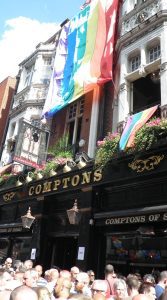
Soho offers one of the longest and most influential examples of queer built environment history in Britain. For centuries, the area’s dense network of narrow streets, lodging houses and late-night establishments placed it on the edge of respectable society, acting as a place of anonymity and secrecy.
Alim Kheraj in his book Queer London: A Guide to the City’s LGBTQ+ Past and Present, stated that Soho was one of the “epicentres of queer activity” as far back as the 1600s. The LGBT Archive records a list of ‘molly houses’ – secret meeting places for gay men, transgender women and gender non-conforming people – dating back to the 18th century.
In the late 19th and early 20th centuries, Soho had become associated with bohemian culture, taking in theatres, music halls, cafés, artists and immigrants. During the 1895 trials of Oscar Wilde, it became clear that the writer frequented the area.
Pre-1967, when homosexuality between men was still criminalised, particular streets and venues acquired significance as places of acceptance and anonymity. Old Compton Street became the symbolic heart of gay Soho, with venues such as Comptons and the Admiral Duncan becoming important LGBTQ+ community landmarks.
Nowadays, of course, Soho is one of the world’s most recognisable LGBTQ+ districts, its rainbow crossings, bars, cafés and nightlife drawing visitors from across the globe.
Professor Pippa Catterall, who has researched LGBTQ+ history extensively, argues that these histories remain important because they challenge the misconception that queer communities are a modern phenomenon.
“It’s important that people grasp that LGBTQ+ people have always existed,” she said. “There is a story of resilience and creativity by LGBTQ+ people in response to social pressure.”
Recognising that longer history is crucial. The emergence of neighbourhoods such as Soho did not mark the beginning of LGBTQ+ communities in Britain. Rather, these districts made visible communities and social networks that had existed, often out of sight, for generations.
Gaybourhoods: Economic decline

Canal Street, Manchester
Urban areas undergoing economic decline also offered opportunities for LGBTQ+ community life to develop beyond mainstream scrutiny. Manchester’s Canal Street demonstrates how wider economic forces could inadvertently create the conditions for alternative communities to grow.
Originally built as part of the Rochdale Canal, the area was once a vital artery of the city’s industrial economy. As canal transport declined and railways became dominant, warehouses fell into disuse and activity along the waterfront diminished.
The Canal & River Trust notes that the area became “dark, unvisited and out of the way”, qualities that made it attractive to gay men seeking spaces where they could meet in private.
A turning point for gaybourhoods

Pride party in Brighton
The late 20th century marked a turning point in how these spaces were experienced and perceived. Legal reforms, activism and changing cultural attitudes enabled greater openness. In Manchester, this transformation became visible in the architecture of the village itself.
The opening of Manto bar in 1990 introduced large glass windows and balconies facing the street, replacing the discreet façades that had previously defined many venues. The ability to see inside marked a decisive shift, as it was an assertion that queer life no longer needed to remain hidden.
Similar patterns emerged elsewhere. Birmingham’s Hurst Street developed within a relatively neglected part of the city centre before becoming a recognised LGBTQ+ destination.
Liverpool’s Stanley Street followed a slightly different trajectory. As redevelopment transformed the city’s earlier informal gay quarter around Queen Square, LGBTQ+ venues increasingly clustered around Stanley Street, gradually establishing a new focal point for community life in the city centre.
Brighton’s Kemptown evolved in yet another way, drawing on the city’s reputation for tolerance, relatively affordable housing and established creative communities. Around St James’s Street, pubs, cafés and LGBTQ+-owned businesses helped create one of Britain’s most enduring gaybourhoods.
Fostering alternative communities

A rainbow zebra crossing in London
While each district developed its own character, they shared a common feature: areas that were marginal to mainstream urban life provided the space in which alternative communities could flourish.
Sociologist Amin Ghaziani in ‘Why Gayborhoods Matter: The Street Empirics of Urban Sexualities’ said that gaybourhoods offer key insights into how safety, visibility and belonging all played a role in shaping these emerging districts:
“Gay districts provide access to courtship and partnership possibilities…provide a perception of safer streets, offer access to queer businesses and institutions, enable social movement organising, and are the conduits of community building.”
In periods of legal restriction and social hostility, concentrated communities offered opportunities for social connection, support and self-expression that were difficult to find elsewhere.
Impact of economic growth
By the 1990s and early 2000s, many established gaybourhoods had become important contributors to local economies.
Restaurants, bars, clubs and independent businesses generated employment and attracted visitors, while Pride events transformed neighbourhoods into major cultural destinations. What had once been relatively hidden communities became increasingly visible components of city branding and tourism strategies.
Over the past two decades, the success of many gaybourhoods contributed to their transformation but also partly to the dilution of their identity.
Rising property values, redevelopment pressures and changing patterns of consumption have altered the landscape of LGBTQ+ nightlife across the UK. The LGBT+ Placemaking Toolkit cites research showing that London alone lost 58 per cent of its LGBTQ+ venues over a ten-year period (20017-2017), illustrating the scale of change.
Furthermore, gentrification increased rents and property costs, making it difficult for independent venues to survive. At the same time, greater social acceptance reduced the need for many LGBTQ+ people to concentrate within specific districts.
The owner of G-A-Y in Soho announced in October 2025 he would close the bar, stating that Old Compton Street has lost its “LGBT identity”. He was also in the press saying that his other LGBT+ venue, Heaven nightclub, faced rent increases of £240,000 on top of an £80,000 automatic increase.
Digital technologies have also changed how communities form and interact. Social media, dating apps and online networks mean that connections once dependent on physical proximity can now be established across entire cities and beyond.
Tension between preservation and change
 While some commentators view this dispersal as evidence of social progress, others advocate caution.
In Queerying Planning, Professor Petra Doan argues that many historic LGBTQ+ neighbourhoods are “losing their special character as safe havens for sexual and gender minorities”. She also points to the role planning decisions can play in shaping these outcomes, writing that “current planning practices have largely neglected the needs of the LGBT community for safe urban spaces in which to live, work, and play”.
Her observations highlight a growing concern among planners, academics and community groups that the forces reshaping cities can unintentionally erode the very spaces that once provided visibility, safety and belonging.
Kelly Canterford, co-chair of Freehold LGBT+, believes these spaces continue to play an important role.
“LGBTQ+ spaces and venues have always been more than just physical places – they are where community, safety and identity have been built in response to exclusion elsewhere.
“While the way people connect is evolving, the need for spaces that foster belonging, visibility and psychological safety hasn’t gone away. In fact, in the current climate, it’s arguably more important than ever.
“For those shaping the built environment, the opportunity is to move beyond seeing these places as legacy or niche assets. It’s about actively protecting and embedding inclusive spaces within our towns and cities – through planning decisions, thoughtful development, and genuine engagement with LGBTQ+ communities. If we value diverse, vibrant places, we have to be intentional about sustaining the communities that create them.”
This tension between preservation and change presents a challenge not only for LGBTQ+ communities, but also for planners, developers and policymakers.
Queer urban design

As traditional gaybourhoods change, the relationship between LGBTQ+ identity and urban space is becoming increasingly complex.
A theory called ‘queer urban design’ challenges traditional, rigid city planning by ensuring LGBTQ+ visibility and safety are woven into the broader urban fabric. Rather than limiting inclusion to isolated ‘gay villages’, this approach advocates for embedding diverse needs throughout all stages of policy, community consultation, and public space development.
Advocate and urban designer Ankitha Gattupalli wrote in her article Queer Urban Design: Planning for Inclusive Cities: “While areas like Soho in London or the Gay Village in Manchester have provided safe havens for LGBTQ+ expression, many individuals still feel compelled to ‘switch’ or hide their identities outside these enclaves.
“Moreover, gentrification and urban renewal threaten even these established queer spaces, often making them unaffordable for the very communities that shaped them.
“To address these challenges, urban planners must think beyond preserving existing queer places and work towards incorporating LGBTQ+ inclusion and safety considerations into all public spaces. This involves using tools like equality impact assessments and actively consulting with LGBTQ+ groups during the planning process.”
Such approaches recognise that belonging is as much spatial as it is social. The design of public spaces, transport networks, streets, parks and neighbourhoods can all influence who feels welcome, safe and represented within the city.
What gay villages tell us about cities
The history of Britain’s gaybourhoods is inseparable from the history of the city itself.
Economic change, legal reform, social movements and cultural transformation have all left their mark on neighbourhoods such as Soho, Canal Street, Kemptown, Hurst Street and Stanley Street. Each reflects a different local story, yet together they reveal common themes of resilience, adaptation and community.
From the hidden geographies of earlier centuries to the vibrant cultural districts that emerged in the late 20th century, these neighbourhoods illustrate how people have continually reshaped urban space in response to changing circumstances.
Their influence also continues to inform conversations about heritage, inclusion and belonging.
For planners, that legacy carries an important lesson for future placemaking. For our academic Charlotte Morphet, diversity should not be an afterthought but a fundamental consideration in the creation of successful places.
She said: “We have to move beyond the idea of designing public space without thinking about the diversity of the people who use it.”
This means that cities should not and cannot be shaped solely by planners, policymakers or developers. They are also shaped by the communities who inhabit them, adapt them and find ways to belong within them.
From the narrow streets of Soho to the waterside warehouses of Canal Street, Britain’s gaybourhoods reveal how questions of identity, belonging and visibility ultimately become written into the fabric of the city itself.


