
‘Survive or thrive?’ Professor Ashley Wheaton calls for radical rethink of UK higher education
Posted on: 14 October, 2026

As he prepares to step down as Vice Chancellor of the University of the Built Environment, Professor Ashley Wheaton used his inaugural professorial lecture to deliver a frank assessment of the financial and structural challenges facing UK universities. From tuition fees and international recruitment to AI and the changing needs of students, he argued that the sector must fundamentally reconsider how, what and whom it teaches.
As some of Britain’s most prestigious universities continue to dominate the international league tables, the wider higher education sector is confronting a rather different reality: financial deficits, falling international recruitment, mounting regulatory costs and growing questions about the value of a degree.
It is a contradiction that Professor Ashley Wheaton, Vice Chancellor of the University of the Built Environment, described as the ‘Oxford illusion’ during his inaugural professorial lecture on Tuesday 13 October.
“Judging the health of UK higher education by Oxford’s ranking is like judging the health of the NHS by the best operating theatre in the country,” he said at the Orangery, Cavendish Square, London. “It tells you the peak is magnificent. It tells you nothing about the foothills.”
View a photo gallery of the event


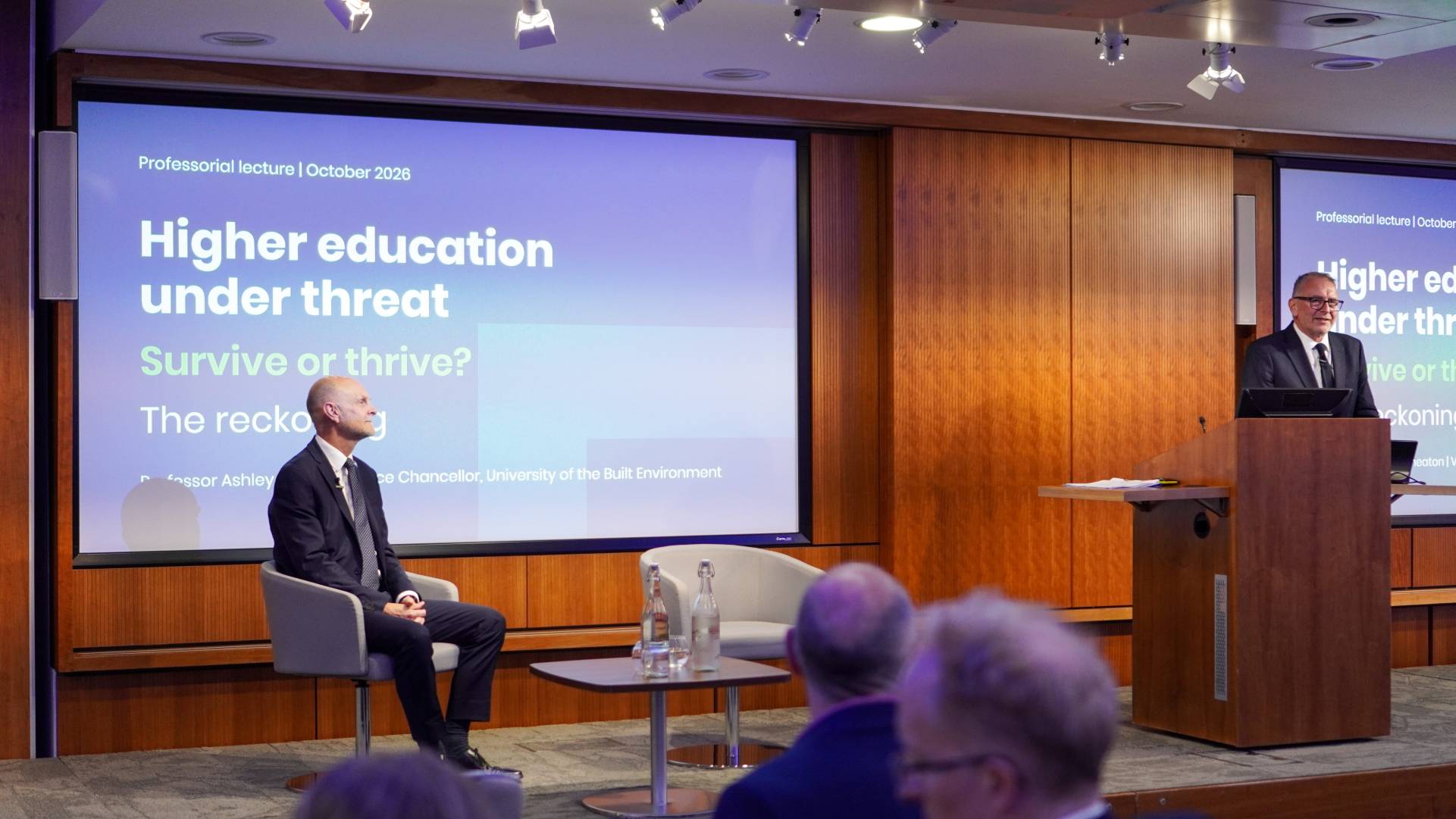








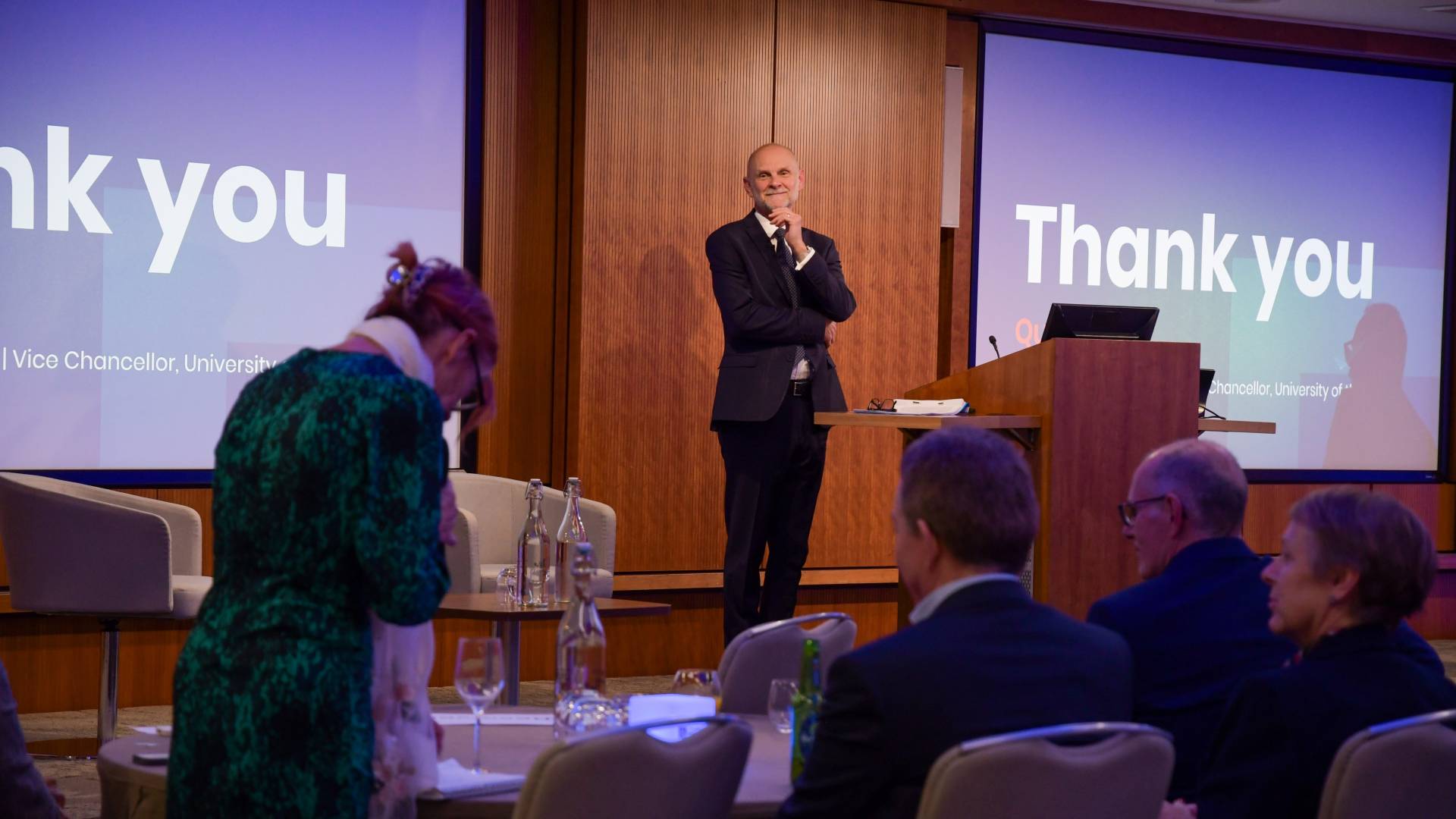

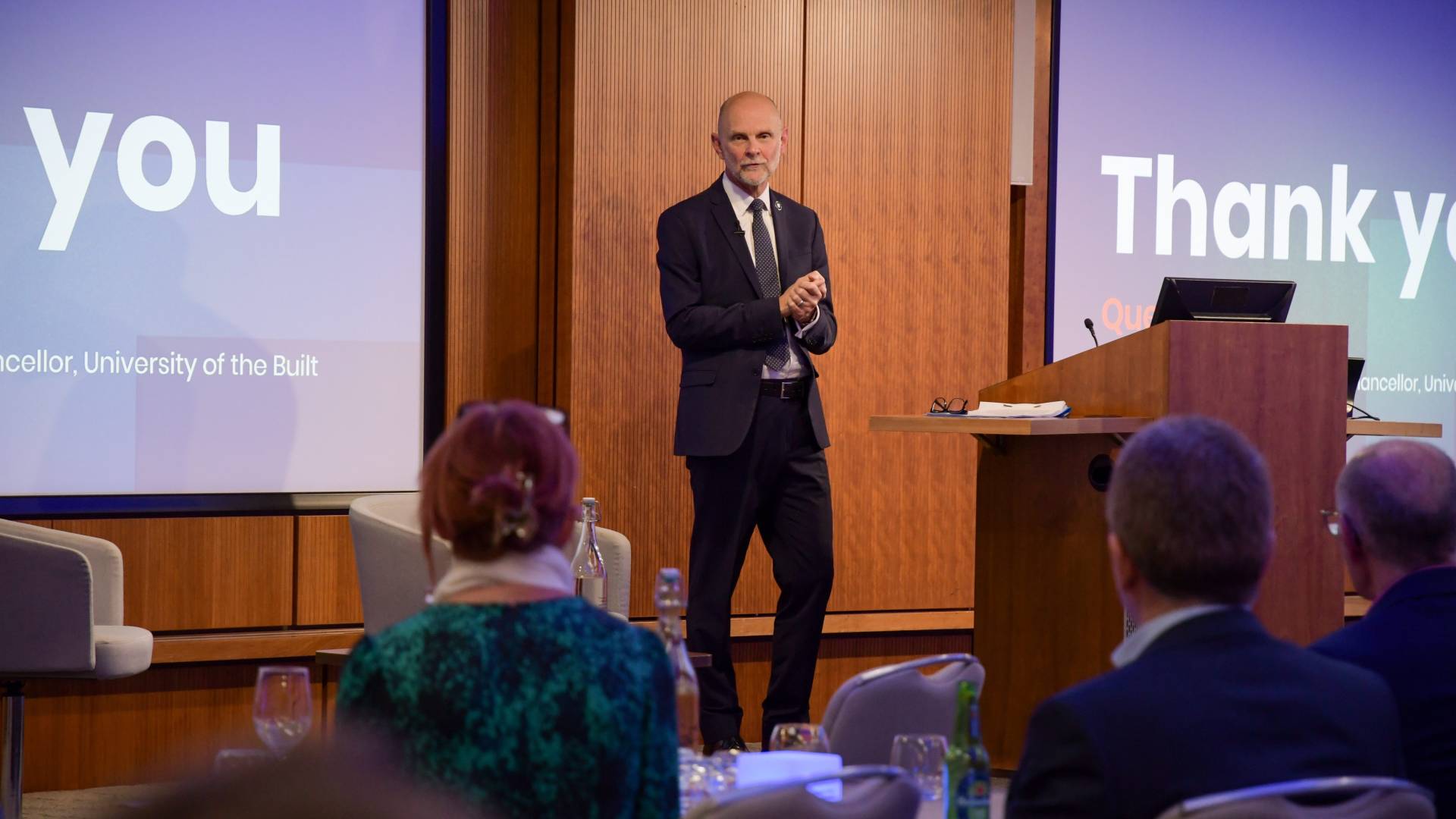



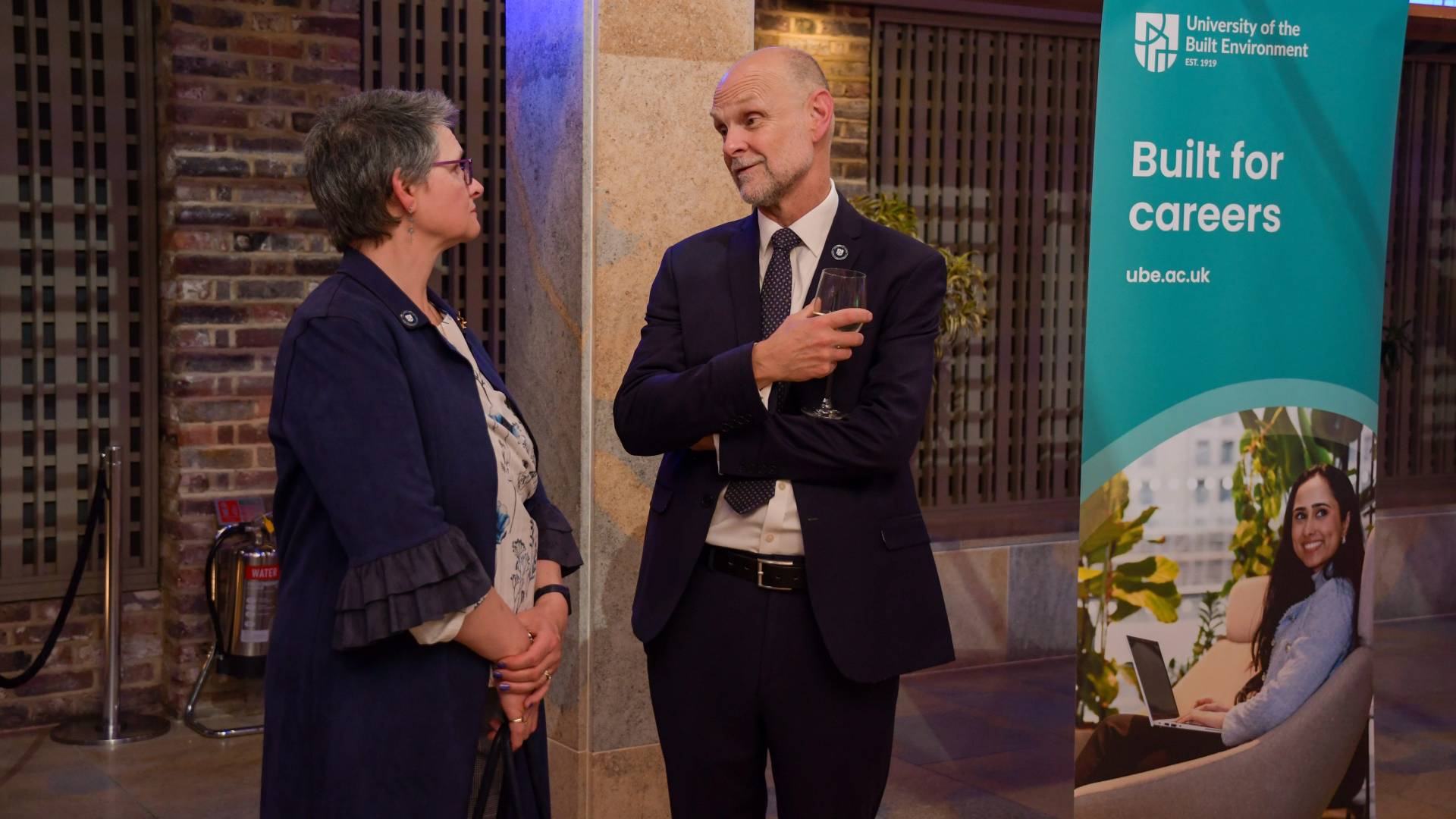




Speaking ahead of his departure from the University at the end of October, Ashley set out an ambitious case for reforming a university system he believes has become dangerously dependent on rising student numbers and tuition fee income.
He laid out his central argument: “We cannot fee or recruit our way out of this. We have to redesign what we offer, to whom, how, and at what price.”
Drawing on evidence from government, industry and higher education research, he identified eight interconnected challenges, from the marketisation of universities to the limitations of the traditional three-year residential degree, and proposes a series of commitments intended to restore public confidence in the sector.

Tuition fees
For much of the past decade, universities have argued that tuition fees must rise to compensate for inflation and increasing operational costs.
In England, the annual fee cap has risen to £9,790 for 2026–27 and is set to reach £10,050 the following academic year. Yet Ashley questions whether higher fees, without a convincing explanation of what students receive in return, can provide a sustainable solution.
“A fee rise is a price, not a strategy. And asking for a higher price without a stronger proposition is the fastest way to lose the public argument we most need to win.”
He points to the financial commitments facing graduates, particularly those on Plan 5 student loans, who must repay nine per cent of earnings above £25,000 for up to 40 years.

Meanwhile, the 2026 Student Academic Experience Survey by the Higher Education Policy Institute (HEPI) and Advance HE found that just 45 per cent of students considered their course good or very good value for money, despite that figure reaching its highest level in more than a decade.
Ashley calls for universities to publish clearer information about graduate outcomes, teaching costs and professional progression, while developing programmes in closer partnership with employers.
“The strongest case for public investment is not that universities need money. It is that the economy needs what universities produce.”
However, he cautions against reducing higher education to employability alone, defending the importance of critical thinking, creativity, citizenship and intellectual enquiry, particularly as artificial intelligence transforms the workplace.
A university market under pressure

Ashley traces many of the sector’s difficulties to the removal of student number controls in England in 2015.
Although the policy widened access to selective institutions, it also intensified competition, allowing prestigious universities to expand their intake at the expense of smaller and less selective providers.
HEPI figures show applications to higher-tariff universities increasing by 40 per cent between 2013 and 2024, while those to lower-tariff institutions fell by 13 per cent.
The financial consequences are becoming increasingly visible, with institutions announcing redundancies, restructuring programmes and mergers. A further challenge lies ahead: demographic projections suggest England’s population of 18-year-olds will peak around 2030 before declining substantially.
Ashley believes the sector must move away from competing for an increasingly limited pool of school-leavers and towards collaboration, particularly in curriculum development.
He proposes shared core modules, joint accreditation arrangements, common digital resources and greater recognition of qualifications between institutions.
“Shared design is not a loss of identity. Our distinctiveness should come from how we teach, the places we serve and the partners we work with — not from writing the same module forty times over.”
He nevertheless acknowledges that competition has supported innovation and greater choice, including the expansion of alternative providers serving mature and working students.
International recruitment

Another major concern is the sector’s reliance on international students, whose higher tuition fees have helped subsidise domestic teaching and research.
Ashley highlights the substantial decline in study visa applications since 2022 and the cumulative impact of immigration policy changes, including restrictions on dependants, the planned shortening of the Graduate route and a proposed levy on international student income.
International tuition fees generated £12.4 billion in 2024–25, according to figures cited in his lecture, representing approximately 23 per cent of sector income.
“We built a cross-subsidy model on a policy variable we did not control,” he said.
His recommendations include diversifying overseas recruitment, developing transnational and online education, improving support for international students and adopting more realistic financial forecasts.
‘Mickey Mouse’ degree debate

Professor Wheaton also addresses the politically charged argument over so-called ‘Mickey Mouse’ degrees, dismissing the expression as a misleading way to judge academic quality.
He notes that subjects once ridiculed, including media studies and sports science, now support economically significant industries. However, he accepts that questions about poor student outcomes, completion rates and graduate progression are legitimate.
“Does this programme, at this institution, deliver for these students? And the honest answer is: not always.”
He proposes evaluating individual courses rather than entire disciplines, using measures that recognise professional accreditation, regional economic needs and public benefit alongside earnings.
Universities, he argues, must also demonstrate a willingness to improve or close persistently underperforming courses rather than leaving intervention entirely to regulators.
The freedom to innovate
Turning to the Higher Education and Research Act 2017 and the Office for Students (OfS), Ashley acknowledges the benefits of stronger student protection, transparency and accountability.
Nevertheless, he argues that increasingly complex reporting requirements, overlapping inspections and compliance costs have created a culture in which universities may be discouraged from experimenting with new approaches.
 “Good regulation should make it safe to innovate. Too often since 2017, it has made it safer not to.”
He advocates a more proportionate regulatory system, with greater autonomy for well-performing institutions and opportunities to trial modular, accelerated and employer-integrated qualifications.
He also challenges the principle of charging largely uniform tuition fees for programmes with substantially different delivery costs.
In particular, he highlights the financial disparity between conventional degrees and degree apprenticeships, whose maximum funding band of £27,000 must cover teaching, assessment and extensive employer engagement across an entire programme.
For subjects such as construction, engineering and surveying, where specialist provision can be expensive but national skills shortages are acute, he argues that funding arrangements should better reflect both educational costs and economic need.
Fitting university around people’s lives
A significant theme of the lecture concerns the changing profile of university students.
Ashley questions why the traditional model of leaving home at 18, studying full-time for three years and graduating at 21 remains the benchmark against which other approaches are judged.
“The three-year residential degree should become one excellent option among many, not the default against which everything else is judged.”
He champions flexible, online and work-integrated education, drawing on UBE’s experience of delivering degree programmes to professionals already employed in the built environment.
The introduction of the Lifelong Learning Entitlement, scheduled for January 2027, could create opportunities for adults to gain qualifications progressively throughout their careers.
He also draws attention to commuter students, whose numbers have risen as accommodation and living costs place greater pressure on families.
With significant proportions of undergraduates combining paid employment with study, he argues that universities must reconsider timetabling, student support, travel costs and opportunities for social participation.
“The commuter student should not be a footnote to the residential model,” he says.
The future workforce
Ashley concludes by placing particular emphasis on collaboration between universities, employers and devolved mayoral authorities.
With national ambitions to build 1.5 million homes, upgrade infrastructure and decarbonise existing buildings, he argues that shortages of skilled professionals represent both a major economic obstacle and an opportunity for higher education.
He proposes regional agreements aligning university programmes with local economic priorities, greater employer involvement in course design, and stronger progression routes between further and higher education.
Artificial intelligence also features prominently, with Ashley calling for AI fluency across every discipline and greater university involvement in developing the skills needed by the existing workforce.
His eight proposed commitments call on institutions to demonstrate their value, collaborate more effectively, address poor outcomes, reform regulation, develop fairer funding arrangements and make education accessible throughout people’s working lives.
Reflecting on the sector’s long history, he acknowledges that some institutions may merge or disappear, while others will need to make fundamental changes to survive.
“Universities have survived for eight centuries by adapting — from the cloister to the civic, from the elite to the mass. This is the next adaptation.”
For Ashley, whose leadership at the University of the Built Environment has centred on professional, flexible and industry-connected education, the question facing universities is ultimately one of public trust.
“A sector that makes these commitments will not need to beg for its future. It will have earned it.”


