‘The cloud is physical’: Why concentrated AI data centres are becoming strategic targets
Posted on: 13 March, 2026
By Linda Serck
Much of the resilience planning around data centres has historically focused on cyber security, power reliability and operational redundancy. Yet recent drone strikes on these facilities raise a broader question about the physical vulnerability of highly concentrated digital infrastructure.
Artificial intelligence is often spoken about as if it exists in the ether. Algorithms float somewhere in ‘the cloud’, detached from geography or politics.
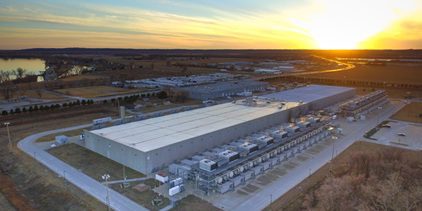
But the reality is that AI depends on vast physical infrastructure: buildings packed with servers, powered by enormous volumes of electricity, cooled by sophisticated systems, and connected by global fibre networks.
Recent drone strikes on data centres in the Middle East have served as a stark reminder that these facilities are increasingly part of the geopolitical landscape.
Professor Samer Bagaeen, Head of Town Planning at the University of the Built Environment, said:
“The strikes in the Gulf underline a simple but often forgotten reality: the cloud is physical.
“AI runs in data centres that depend on energy, cooling and connectivity, and when those facilities sit in geopolitically exposed regions, they become part of the strategic landscape of modern conflict.”
How governments have historically viewed data centre risk
The UK Government has, of course, already recognised the need to protect data centres. For example, a Ministry of Defence Global Strategic Trends report states:
“In the future, the ability of governments and businesses to make decisions will depend even more fundamentally on their access to data, and the quality of their decisions will be determined by their ability to make sense of the information they access. The physical and digital protection of data centres will consequently become more critical.”
The UK formally designated data centres as Critical National Infrastructure in 2024, recognising their role in supporting essential services such as finance, healthcare and communications.
However, the Government’s resilience strategy is arguably incomplete.
The Parliamentary research briefing entitled ‘Data centres: planning policy, sustainability, and resilience’ focuses heavily on cybersecurity, operational resilience, energy supply and planning policy, but does not mention physical military threats.
Recent drone strikes on cloud infrastructure in the Gulf have demonstrated that data centres can be physically targeted in conflict, damaging facilities and causing service disruptions.
According to an article in The Guardian, security experts and analysts point out that, like most high-value and highly visible facilities, data centres are designed to prevent intruders or sabotage, not to withstand missiles or military drones.
This makes them vulnerable in geopolitical conflicts.
The hyperscale concentration issue

Hyperscale facilities deliberately concentrate huge computing power in a few locations because it is:
- Cheaper to operate
- Easier to cool and power
- Easier to connect to fibre networks
- More efficient for AI training clusters
But the flip side is systemic risk. If one facility fails, services can shift elsewhere. If multiple facilities in the same region are disrupted, the impact could spread much more widely.
This is why hyperscale cloud providers build ‘availability zones’ so workloads can move between data centres within a region if one fails.
However, these zones are usually within tens of kilometres of each other, meaning a major regional disruption could affect several at once.
The global data centre boom
Demand for computing power has exploded in the age of AI. Training large language models and running cloud-based services requires immense computational resources, driving a global construction surge.
According to Statista.com, there are currently more than 12,000 operational data centres worldwide.
The United States dominates the landscape with 4,165 facilities, while the United Kingdom comes second with a reported 499, followed closely by Germany with 487.
The United Kingdom’s data centres are concentrated largely around London and the Thames Valley, which accounts for roughly 80% of the UK’s total data centre capacity. This makes it Europe’s largest digital infrastructure hub, according to an insights report from the real estate and investment services firm, CBRE.
The firm also states:
“Demand from hyperscalers will again drive much of the need for capacity in the capital, although requirements from AI providers are starting to make their presence felt and will also be dominant.”
The concentration of data centres occurs where connectivity, reliable energy supply and large markets converge. This is why the UK government is backing major data centre developments on Green Belt land near London, including a contentious 20.2-acre project at Manor Farm in Slough and others in Buckinghamshire.
Data centre developers argue these facilities are crucial to running the country. No longer simply hosting websites or streaming services, they power financial systems, logistics networks, healthcare databases, government operations, and, increasingly, the AI systems shaping economic and military capabilities.
Professor Bagaeen said:
“What we are seeing is the strategicisation of digital infrastructure. Data centres were once viewed as neutral back-end utilities, but as AI capability becomes central to economic and military power, these facilities increasingly look like critical national infrastructure, and therefore potential targets.”
How and why are data centres vulnerable to physical attack?
- AI training clusters concentrate extraordinary computing power in relatively few locations known as hyperscale facilities.
Hyperscale facilities may contain tens of thousands of Graphics Processing Units (GPUs) capable of training models that influence finance, defence systems, autonomous technologies, and advanced analytics.
Factfile: What is a hyperscale facility?
Hyperscale facilities are very large data centres built to handle enormous amounts of computing power, storage and network traffic. They are designed to scale rapidly and efficiently as demand for cloud computing and AI grows.
The term ‘hyperscale’ comes from the idea that these facilities can scale computing capacity almost infinitely by adding more servers and networking equipment.
What makes a data centre ‘hyperscale’?
While definitions vary slightly across the industry, a hyperscale data centre typically has:
- At least 5,000 servers
- Thousands of GPUs or specialised AI chips
- Hundreds of thousands of square feet of floor space
- Extremely high electricity demand (often tens or hundreds of megawatts)
According to Synergy Research Group, there were over 900 hyperscale data centres globally by 2024, and the number continues to grow rapidly as AI demand expands.
Most are owned or operated by major cloud companies such as:
-
- Amazon Web Services
- Microsoft
- Meta Platforms
- Alibaba Cloud
- The concentration of data centre locations make them a potential target.
Many major facilities cluster in energy-rich regions with cheap power strategic connectivity points near submarine cable landings. While these locations maximise efficiency and connectivity, they can also create concentration risk. In the UK, for example, the dominance of the London-Slough corridor means that a large share of the country’s cloud capacity sits within a relatively small geographic area. Globally, several fast-growing AI infrastructure hubs lie in geopolitically sensitive regions, including parts of the Middle East and East Asia.
- The physical networks that connect data centres are also vulnerable.
Subsea cables carry around 95% of international data traffic, making them critical yet exposed infrastructure linking data centres across continents. - The digital economy’s dependence on data centres means disruption can ripple rapidly across society.
When major cloud infrastructure fails, payment systems, communications platforms and logistics networks can all be affected within minutes.
This growing concentration of economic and technological power makes them increasingly attractive targets in geopolitical conflict.
Designing resilience against physical attack into digital infrastructure
The challenge for governments and planners is therefore how to protect critical digital infrastructure while maintaining the benefits of global connectivity.
- Decentralise data centre hubs
One strategy is to distribute computing capacity across multiple regions rather than concentrating it in a handful of global hubs.
This reduces the systemic risk that a single disruption could affect millions of users or businesses.
The UK is already planning new facilities outside London in regions including the Midlands, the North of England and Scotland.
- Hardened physical design
As data centres become more strategically important, future facilities may incorporate blast-resistant structures, wider security perimeters and protected cooling or fuel systems. Similar protective design approaches are already used in defence and energy infrastructure.
- Airspace and perimeter security
Operators may also adopt enhanced perimeter protection such as surveillance, geofencing and counter-drone technologies, aligning data-centre security more closely with that of airports or power stations.
Conclusion
Artificial intelligence is reshaping not only the global economy but also the physical geography that underpins it. The data centres powering AI are no longer obscure technical facilities; they are emerging as strategic assets whose location, resilience and connectivity will help shape national competitiveness and digital sovereignty.
As computing power concentrates in ever larger hyperscale campuses, the challenge for planners and policymakers is becoming clearer. Efficiency has driven the architecture of the cloud for decades. The next phase may be defined by how societies balance that efficiency with resilience in an era of more complex physical and geopolitical risk.
The cloud may feel intangible. In reality, it has a footprint, an energy demand and increasingly, a strategic significance. Designing the infrastructure of the AI age will therefore mean thinking not only about how much computing power we build, but where and how we build it.
Want to be part of the built environment conversation?
The University of the Built Environment, established in 1919, is a specialist university that offers a broad range of online programmes related to the built environment and sustainability. Explore all courses here.