Nick McKeogh: ‘The future belongs to those who can connect dots’
Posted on: 2 February, 2026

Speaking at the University of the Built Environment’s Winter Graduation Ceremony 2026, Nick McKeogh, Chief Executive and Co-Founder of NLA – the membership body for London’s built environment sector, sets out why today’s graduates are entering a sector with global impact, shared responsibility and unprecedented opportunity.
There are moments, Nick McKeogh believes, when timing matters as much as talent. Addressing graduates at the University of the Built Environment ceremony on Friday 30 January 2026, he argued that few moments could be more significant for those entering the built environment professions.
“And what a moment to be joining this sector,” he told the audience. “Because the built environment is not a niche profession. It is not a supporting act. It is — quite literally — the stage on which modern life happens.”
 Nick began by setting out the sheer scale of the sector graduates are stepping into. Drawing on NLA’s research, he highlighted that the built environment underpins around £1.3 trillion of economic activity in the UK, supports nearly four million jobs and accounts for a quarter of national gross value added.
“It connects investment, innovation, communities and culture,” he said. “And globally, the opportunity is even more profound.”
Nine billion city dwellers by 2080
By 2080, he noted, more than nine billion people are expected to live in cities, up from around 2.3 billion in 1980. That growth will demand homes, infrastructure and places delivered at a scale humanity has never seen before.
“That is why what you are graduating into today is not just a career,” he told graduates. “It is a calling.”
For Nick, the built environment sits at the heart of the defining challenges of our time, from climate change and technological transformation to affordability, accessibility and resilience.
“None of these can be solved without you,” he said. The choices made by planners, engineers, designers, surveyors, developers and policymakers will determine whether cities become inclusive or divided, sustainable or extractive.
The UK is a world leader in the built environment
Despite the scale of those challenges, Nick struck an optimistic note. The UK, he said, remains world-leading in the built environment, recognised globally not just for design quality but for professionalism, governance, education and innovation.
“You are stepping into a sector that the world looks to,” he said, “and one that desperately needs your skills, your values, and your energy.”
That blend of commercial success and social purpose, he argued, defines the best of the profession. Reflecting on colleagues and leaders he admires, Nick emphasised that leadership in the built environment is not simply about what is built, but how people lead, who they include and the long-term impact they choose to make.
“It can be a sector where you build a career — and leave a legacy,” he said.
Why Nick McKeogh co-founded NLA
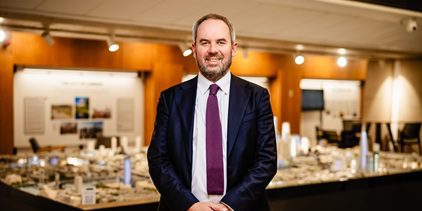
Nick’s own journey into the sector was shaped early by collaboration. Growing up around architectural models, including the City of London model created by his father’s firm, Pipers Model Makers, he witnessed city leaders, planners, architects and developers gathered around a shared physical vision.

“What struck me wasn’t just the buildings,” he said. “It was the power of collaboration.”
That experience ultimately led him away from an initial plan to study English and towards civil engineering, driven by a desire to help shape the physical world. But it was at university that he recognised a deeper problem: despite working on the same places, built environment disciplines rarely spoke to one another.
“That gap — between professions that should be collaborating — is what ultimately led me to co-found NLA,” he explained.
‘Learning never really stops’
Progress, he argued, does not come from silos, but from shared understanding and learning each other’s languages. It is also why partnerships between organisations such as NLA and the University of the Built Environment matter, supporting graduates not just at the point of qualification, but throughout their careers.
“In a sector evolving as fast as this one,” he said, “learning never really stops.”
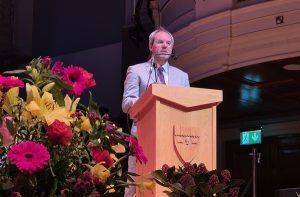
As he closed his speech, Nick offered graduates three reflections: Be ambitious, but anchor that ambition in purpose; stay curious across boundaries, because “the future belongs to those who can connect dots, not just draw them”; and take pride in the profession they are entering.
“You are entering a profession that quite literally shapes lives,” he said. “The streets people walk, the homes they live in, the cities they love – you will help create them. That’s a privilege. And it’s a responsibility.”
His final message offered an inspiration to the packed Concert Hall in Reading: “The sector needs you. The world needs you. And I can’t wait to see what you build next.”
Explore our Part 2: MArch in Designing Architecture programme