Michaela Wain: ‘I couldn’t earn this money being a hairdresser’
Posted on: 9 February, 2026

Guest speaker Michaela Wain will bring honesty, humour, and hard-earned wisdom to the University of the Built Environment’s Apprenticeship Awards this February. Ahead of the event, she spoke to us about finding her way into construction, the surprising legacy of The Apprentice, and why empowering the next generation – especially women – is about confidence, purpose and having real conversations about money.
Michaela Wain, from Bolton in Greater Manchester, is one of the construction industry’s most recognisable champions.
A larger-than-life persona full of spritely ebullience, she is a successful business owner, property developer, founder of the UK’s largest construction magazine ‘Design and Build UK’, and was a finalist on BBC’s ‘The Apprentice’. Her entrepreneurial spirit has seen her build, scale, and sell several companies across construction, facilities management, and utilities.
More recently, she has become a powerful advocate for women in construction, launching the first-ever ‘Women in Construction Awards’, alongside training programmes, accreditations, and a growing charity focused on supporting women to succeed and stay in the industry.
‘I did a degree in Religion!’
However, Michaela’s route into construction was not a direct one, despite having a stepdad as a builder, a dad as an engineer, and a mum as an estate agent.
“I actually went to university and did a degree in Religion and Special Needs,” she laughed. “Absolutely nothing to do with construction whatsoever.”
 Yet somehow, she found herself stepping into the industry, and once there, she never looked back.
“What keeps me in construction is that I absolutely love it,” she explains. “I love seeing the change in landscape. I love changing people’s lives when you’re building, when you’ve done these projects, the impact it has, the lasting legacy.”
For Michaela, construction is far more than bricks and mortar.
“It’s not just about the building itself. It’s what that building is used for later on. It’s the people whose lives it affects. Hopefully positively.”
That sense of purpose has been a constant driver throughout her career. But so has something many people shy away from discussing.
“The money,” she said. “Nobody ever talks about the money.”
Financial freedom
Culturally, conversations about earnings can feel uncomfortable, but Michaela is unapologetically and refreshingly open.
“I couldn’t earn this money being a hairdresser, unless I was like Nicky Clarke or something,” she said.
For her, financial freedom is a motivator, particularly for young people choosing careers, and with that comes honesty about salary expectations.
“I want to be happy in work, of course,” she said. “You could be earning a million pounds a year and be miserable. That’s not the goal.
 “But what does make me happy is being able to have financial freedom and go to the Maldives with my children,” she adds honestly. “I’m not going to lie.”
Michaela believes young people deserve clear, real conversations about career paths, earnings and opportunities.
“I think also southerners aren’t as open to this conversation as northerners, who tell everybody everything. We can have really open conversations about who’s earning what, where you should be going.
“My family were very open about it. They’d say, ‘Do this because it will be good for you’.
“We need to be having these conversations with young people to inspire them and show them what’s possible.”
It is one of the reasons she is so passionate about apprenticeships and clearer progression routes within the built environment.
“That bridge from the tools into technical and professional roles is so important,” she said. “People need to understand what that actually looks like, and what it can lead to.”
The surprising legacy of The Apprentice
Of course, many people first encountered Michaela on TV as a finalist on The Apprentice in 2017.
But the biggest surprise from the experience was not the cameras, Lord Sugar, or even the pressure.
 “I ended up having a child with one of my fellow candidates,” she laughed. “That definitely wasn’t on the bingo card.”
Beyond that unexpected twist, the show also gave her something incredibly powerful: confidence.
“When I first met Lord Sugar, I was so nervous I could barely speak,” she recalled. “He told me I was the most successful candidate they’d had on at that point. We were turning over about £4 million.”
“I honestly thought everyone else would be the same.”
It did not take long for reality to sink in.
“Within a few days I realised, actually, I know a lot more than I thought I knew,” she said. “Some people were completely incapable and got fired very quickly.”
The experience shifted her mindset.
“I realised I was more than capable of being in that room. And if someone opens the door and lets you in, get comfortable.”
It is advice she now shares widely, particularly with apprentices and young professionals.
“If you’re there, you’re there because you deserve to be there,” she said simply. “Crack on.”
‘I felt this inner need to help’
Interestingly, Michaela never saw herself as a ‘woman in construction’ until others framed her that way after The Apprentice aired.
“People started saying, ‘Thank you for representing women in construction,’ and I was like, I didn’t even realise that’s what I was doing,” she said.
But behind the scenes, something deeper was happening.
“Two different women came to me and told me horrific things they’d experienced at work,” she said. “And I just felt this inner need to help.”
Suddenly, reality TV glamour felt hollow.
“I was offered to go on Big Brother,” she said. “But it just didn’t feel right when all these women were telling me about the problems they were facing.”
Instead, she chose a different path.
“That’s what sent me on this journey of women in construction,” she explains. “That was in 2017, nearly ten years ago now.”
Since then, she has helped create what she calls a “really positive space” for women.
“Yes, the problems need to be spoken about,” she said. “But we’re not going to attract more women if we only talk about doom and gloom.
“We also need to talk about the brilliant work women are doing.”
Confidence, progression, and the gender pay gap
Michaela is also refreshingly honest about the realities behind the gender pay gap in construction.
“There is a gender pay gap,” she said. “But it’s not usually that a woman in the same role is being paid less than a man.”
“The issue is that more men are in the higher-paid roles.”
And she is clear that responsibility sits across the industry.
“Women have to put themselves forward,” she explains. “But employers also need to identify great women and encourage them.”
She points to deeply ingrained social conditioning.
“From being little girls we’re told to be quiet, to look pretty, to smile,” she said. “Then suddenly as adults we expect women to say, ‘I’ll go for that job’. That’s not reality.”
Her own upbringing was different.
“My mum treated me like a boy,” she laughed. “She’d say, you’ve got to have bigger balls than any man to succeed.”
“She never said, ‘Don’t climb the tree, you’ll fall.’ She said, ‘Get up there and beat your brother to it.’”
That confidence shaped her career.
But she knows many women have not had that foundation.
“That’s why employers need to spot talent and say, ‘Go for this. You can do it.’”
‘An electrician can earn four times more’
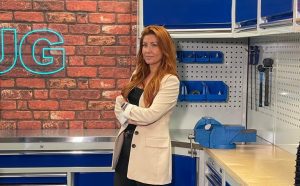
One of Michaela’s proudest achievements comes not from boardrooms or awards ceremonies, but from visits to alternative education schools for young people who have been excluded from mainstream education.
“When you go in, 100 per cent of the boys are doing trades like bricklaying and electrics,” she explained. “And 100 per cent of the girls are doing nails, beauty or admin.
“If they don’t know someone in construction, they don’t know it’s an option,” she said.
Michaela makes it her mission to intervene early and present herself as someone these girls can relate to.
“I tell them, I get my hair done, I get my nails done, I love beauty treatments,” she said. “There’s a need for it if that’s your passion.”
“But I also explain that for the same hours worked, an electrician can earn four times more.”
For many of the girls, often from underprivileged backgrounds, the reality of money and opportunity hits home.
Her proudest success story?
“A young girl who looked like a supermodel,” she smiled. “She switched from doing nails to becoming a bricklayer. She finished her apprenticeship and absolutely loves it.”
The joy of apprenticeships and nurturing talent
Michaela has employed countless apprentices across her businesses over the years, watching many grow into long-term team members and even business owners themselves.
“We’ve got apprentices who joined us in the first year of one of our companies and they’re still with us 13 years later,” she said.
“They’ve grown with the business, had children, built their lives.”
She believes nurturing apprentices is undervalued across the industry.
“If you treat them well, they stay,” she said. “Letting people walk out the door costs businesses a fortune.”
For Michaela, creating a culture where people feel part of something bigger is key.
“When someone grows with your business and buys into your belief, they want to help you succeed.”
A message for the next generation
As Michaela prepares to address apprentices, employers and industry leaders at the University of the Built Environment Apprenticeship Awards, her message is clear: Construction is a career of purpose, opportunity, and impact.
“It changes lives,” she said. “It shapes communities.
“It can give you a life you’re proud of.”