Built environment workforce planning: ‘We need to be more future-focused’
Posted on: 5 February, 2026

By Nick Perkins
Head of BEFA
The University of the Built Environment recently launched the Built Environment Futures Assembly (BEFA), a powerful leadership forum for the built environment sector, operating at the critical intersection of education and professional practice to build future-facing capacity, capability and competency.
Following our previous articles on future workforce needs and AI, currency of competency and the implications of these for stakeholder organisations, we now examine the importance of strategic workforce planning.
Watch a video outlining this topic from Mark Farmer, BEFA Chair and author of influential government reviews into built environment skills, ‘Modernise or Die’ and ‘Transforming the Construction Workforce’.
Know the supply and demand
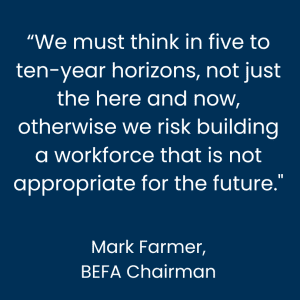 The sector faces a dual challenge. Do we have enough people for the work ahead and do we have people with the right skills for how that work is changing? Demographic pressure, evolving delivery models and the net zero transition increasingly make reactive hiring untenable. The industry needs strategic workforce planning grounded in better foresight.
This begins with a structured view of likely demand. Scenario planning can model different trajectories for housing, infrastructure and retrofit, with horizon scanning identifying emergent roles such as retrofit coordinators, digital construction leads or AI-assisted planners.
Alongside demand, we need an accurate baseline of current capacity, entry rates and attrition. The ageing profile of parts of the workforce and competition from other sectors must be factored into projections. The analysis should distinguish between headcount and skill mix, since technology will change the composition of roles.
Close the gap deliberately
Once gaps are understood, the following steps could help the sector close its workforce gap.
- Attract: Strengthen pathways for new entrants through schools outreach, apprenticeships and conversion routes for mid-career changers.
- Train: Align curricula and provision to the forecast mix of skills, not historical patterns. Use modular courses and micro-credentials to reskill at pace.
- Retain: Invest in progression, flexible working and inclusive cultures so people stay and grow.
- Redeploy: Support transitions from declining roles to growth areas with structured upskilling and supervised practice.
How BEFA could help
With better foresight and coordinated action, the sector can build the workforce it needs, when and where it needs it.
To support strategic workforce planning, BEFA could play a pivotal role in aggregating data on labour demand, current supply and emerging roles across the built environment. By synthesising this information into concise, accessible briefs, BEFA would help stakeholders make informed decisions about future workforce needs.
Additionally, BEFA could publish practical playbooks that guide organisations in redeploying talent into high-growth areas such as retrofit and digital delivery. These resources would offer structured approaches to upskilling, role transition and competency development, helping to ensure that workforce shifts are both efficient and effective.
Finally, BEFA could convene policymakers and industry leaders to align incentives for training where workforce gaps are most systemic. By fostering collaboration and shared accountability, BEFA would help create a more responsive and resilient skills ecosystem across the sector.
Get in touch with BEFA here.