Belonging: How our inclusive online learning model is reshaping opportunity
Posted on: 16 February, 2026
By Linda Serck
New government-commissioned research has highlighted the structural barriers disabled people continue to face throughout their educational journeys, from inconsistent support to limited accessibility. At the University of the Built Environment, an online-first model combined with tailored pastoral care is helping students with disabilities and learning differences engage fully with their studies and progress with confidence.
New research published on 29 January 2026 has laid bare the lived experience of disabled people in education, drawing on more than a decade of qualitative evidence.
 The Disabled People’s Lived Experience of Education in the UK review, commissioned by the previous Conservative government, found that disabled learners continue to encounter structural barriers.
These include inflexible systems, gaps in staff understanding, and inconsistent support during transitions between education and employment.
These findings echo longstanding concerns across higher education, where access alone does not guarantee participation on equal terms.
The evidence points to the importance of flexible delivery, informed staff training and tailored adjustments in enabling disabled students to engage fully in their studies and progress with confidence.
Our online delivery model
At the University of the Built Environment, accessibility and inclusivity are built into the framework of our online delivery.
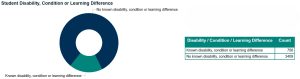
As of July 2025, 756 of the University’s 4,125 students have a known disability, condition or learning difference – 18 per cent of the student body. They are studying across undergraduate, postgraduate and apprenticeship programmes.
The institution’s primarily online model removes several of the practical barriers that can make traditional campus study difficult.
 For students with physical disabilities or long-term health conditions, there is no daily negotiation of inaccessible buildings or exhausting travel schedules.
Students managing fluctuating mental health conditions or neurodivergence are able to study within environments they control, revisit recorded content and structure their time in ways that support focus and stability.
Learners with dyslexia, dyspraxia and other specific learning differences engage with structured weekly activities, multi-format resources and integrated assistive technologies designed to support reading, writing and organisation.
Dr Batul Daulby, Principal Educational Psychologist at CF Psychology, which partners with the University, explains:
“Remote and online learning significantly improves access to higher education for neurodivergent students, including those with SpLDs, ADHD and autism. Studying outside of traditional set-ups like lecture halls and classrooms allows students to learn in environments they can choose and control, with the accommodations and routines that help them regulate attention, sensory input and energy levels.
“Removing the need to travel and reducing exposure to busy campus environments means students are not having to process complex social and sensory demands alongside academic content, which can lower cognitive load and anxiety and allow them to focus more fully on learning.”
Removal of digital barriers

Online learning alone is not enough, however, to claim the status of being inclusive. Platforms should integrate assistive technologies such as screen readers, speech-to-text/captioning, text-to-speech and organisational tools into everyday study and assessment.
The importance of digital design is echoed by Disabled Students UK in its Access Insights 2025 report, which highlights persistent gaps in disabled student support.
A spokesperson for the organisation said: “The true value of online learning lies in the removal of digital barriers: accessible platforms, clear captions, well-structured resources, and adaptable assessments offer students increased agency.
 “When digital accessibility is embedded in pedagogical design, online learning removes barriers and creates opportunities for disabled students to engage confidently and participate both fully and equitably.”
Alongside delivery, there is support. The University’s Disability and Welfare Team works within the social model of disability, recognising that barriers arise from environments rather than impairments.
A spokesperson for the team said: “All students at the university benefit from a range of accessibility features built into the Virtual Learning Environment… The Disability and Welfare Team works towards the social model of disability, where we recognise it is the world around us that causes disability, not people’s impairments.”
Students are offered reasonable adjustments, specialist non-medical support, assistive technology and practical strategies tailored to their circumstances.
For apprentices, many of whom are balancing study with employment and professional responsibility, that flexibility can be decisive. The ability to integrate recorded teaching, digital tools and pastoral guidance around working patterns allows learners to maintain momentum without compromising their health.
Staff development forms part of the same approach. Inclusive practice is therefore distributed across teaching teams, rather than concentrated in a single service.
Training videos for staff
See our Disability and Welfare Team’s training videos on Vimeo here:
- Funded Assistive Technology (AT)
- Learning differences
- Understanding masking
- Free Assistive Technology (AT)
- Soundscape for study
For students, the impact is tangible.
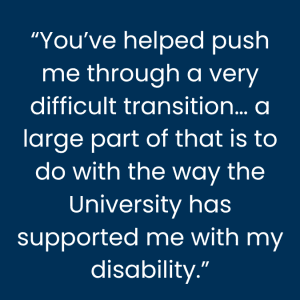
One said in a testimonial: “You’ve helped pushed me through a very difficult transition… a large part of that is to do with the way the University has supported me with my disability.”
University support plans
A postgraduate learner described the practical consequences of specialist assessment and tailored tools: “I am immensely grateful for the SpLD assessment and support plan funded by the University… the tailored technology tools and 1:1 assistance have enhanced both my educational and professional life.”
For the University of the Built Environment, which is educating future surveyors, planners, architects and construction professionals, inclusion is inseparable from professional standards.
Our learning model relies on accessible design, personalised care and academic rigour working in concert.
For disabled students and apprentices alike, the outcome is a learning experience in which they are recognised, supported and equipped to move forward and achieve their goals.