How a Building Control degree transformed Ruth MacEachern's career
A student case study with Ruth MacEachern
Average read time: 5 mins
10 August 2026

Ruth MacEachern studied late into the evenings while working full-time and caring for her husband, whose serious brain injury means she must always be ready for an emergency. Five years later, the Building Control graduate is helping to shape industry policy, training and technical debate across the UK.

Some evenings, Ruth MacEachern studied upstairs with every door left open. A university lecture played through one headphone, while her other ear remained tuned to the sounds of home, ready to respond if her husband needed her.
On other nights, she watched lectures again from the sofa, fitting construction technology, fire safety and technical drawing around a full day at work and the unpredictable demands of caring for someone with a serious neurological condition. Sundays became study days too, and the degree was mentally filed alongside her working week as a form of “overtime”.
For Ruth, 35, and living in Harrogate, North Yorkshire, study had to bend around real life.
“I knew that if it didn’t work for us and around our life, then I wouldn’t be successful,” she said. “I could work, come home, look after my husband and then begin my studies. If he was unwell, which happened a lot, I could start and stop, and I had the flexibility to take my studies elsewhere.”
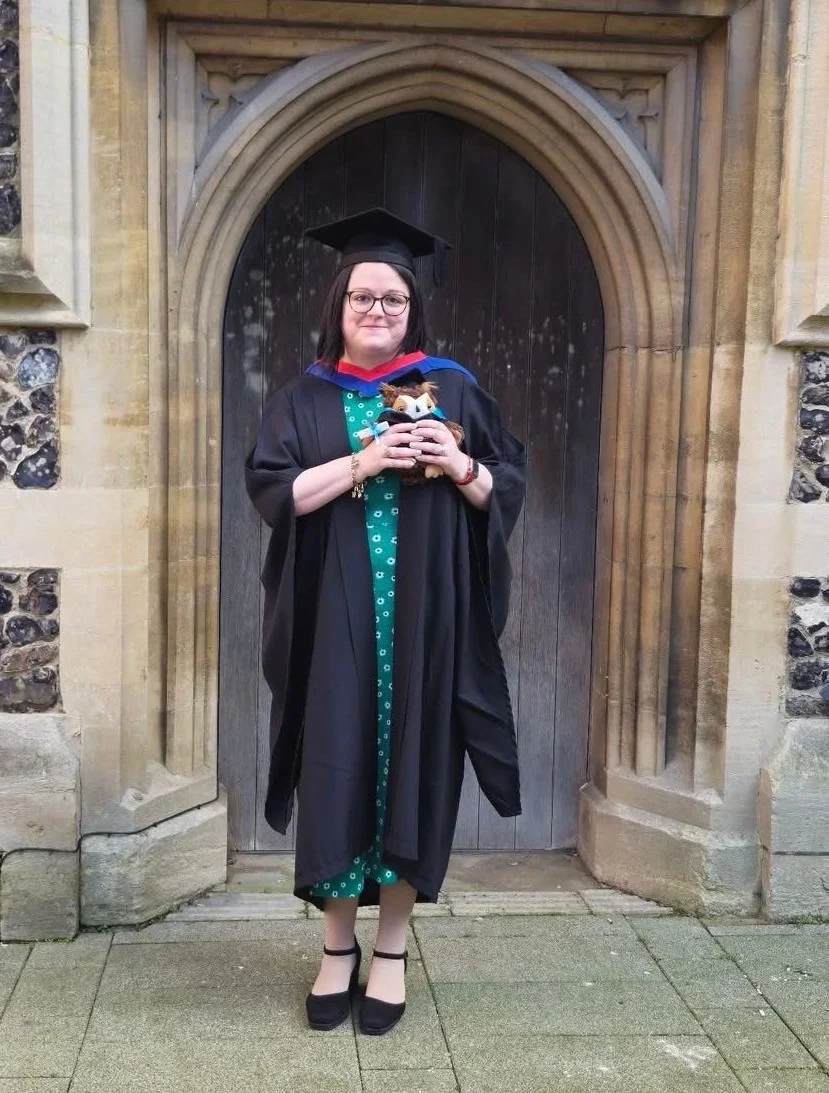
Ruth joined the Autumn 2020 intake of the BSc (Hons) Building Control as a self-funded student, graduating in January 2025. Today, she is Product Manager and Policy Advisor at ventilation manufacturer envirovent, with an industry profile that encompasses technical writing, public speaking, policy consultations and professional working groups.
Becoming the person with answers

Ruth’s interest in Building Control grew gradually from the questions landing on her desk. Before moving into her present role, she worked in envirovent’s technical estimation and sales teams, regularly communicating with Building Control bodies about ventilation, fire safety and other regulatory requirements.
She began to notice what she regarded as gaps in knowledge and competency. As the construction industry faced greater scrutiny following the Grenfell Tower fire, colleagues increasingly turned to Ruth when regulations needed interpreting or a technical query became tangled.
“I became the ‘go-to’ person at work for regulatory questions,” she said. “I wanted to see how I could take that further, so I began looking independently at the options available.”
Building Control appealed because it sat at the intersection of several subjects already present in her working life: construction, legislation, safety, technical design and the performance of buildings.
Building control professionals assess plans and specifications, inspect work and apply regulations covering areas including structure, fire safety, ventilation, thermal performance and accessibility. The occupation calls for technical judgement alongside diplomacy, communication and the confidence to challenge where standards are not being met.
When she felt she wanted to study for a degree, she discussed the idea with her manager and the head of the technical team, both of whom encouraged her, before calling the University to check the process and applying online.
The ability to study from home was decisive, as was the course’s professional accreditation. The current BSc (Hons) Building Control is accredited by CABE, CIOB and RICS and can be studied online on a full-time or part-time basis.
“I absolutely loved the whole course,” Ruth said. “A lot of it put me outside my comfort zone and, at the start, I was convinced I would be at a huge disadvantage. It opened up my interests, skills and strengths, though, and I relished all of it.”
Making study fit around care
Ruth’s husband sustained a brain injury following an accident in 2011. He suffered a stroke and lives with epilepsy, brain damage, cognitive impairment and dyspraxia.
His seizures have no predictable trigger and can be severe, making study flexibility more than a matter of convenience. A scheduled study slot could disappear instantly if his condition changed.
“I treated studying for my degree as an extension of work,” she said. “I would complete my working day, come home and sort everything, then spend my evenings after dinner studying as ‘overtime’. I loved my modules, which definitely helped, but I also had to get myself into the right mindset so it wouldn’t become an unmanageable task.”
Ruth organised her time by beginning assignments early, planning around competing deadlines and trying to prevent work from accumulating.
She speaks warmly of her tutors and the wider support available from the University.
“The disability and wellbeing team were excellent, as were the module leaders and support staff,” she said. “I couldn’t thank them enough. I was always very open and honest, and I spoke to the team if I was struggling.”
That openness was accompanied by formidable self-discipline. Ruth funded the degree herself and completed the work during evenings and every Sunday, without specific time away from her job. She graduated top of her class and received an award for her dissertation, achievements that carry particular weight for someone who admits to struggles with confidence and self-esteem.
“I am so proud of myself for going forward with the degree, giving it my all and getting such good marks and feedback, as well as my award,” she said. “It was a definite confidence boost.”
From product knowledge to policy influence
Her studies were already positively impacting on her career before she graduated. In 2021, only a year after commencing the degree programme, Ruth moved into envirovent's research and development department as a Product Manager. Her growing regulatory knowledge soon expanded the boundaries of the role.
She began reporting regulatory changes to stakeholders, writing technical articles for envirovent and external publications, and becoming more closely involved with trade associations. Her ability to translate complex requirements into useful, accessible guidance was developing alongside her academic knowledge.
Today, policy sits formally within her job title. She chairs working groups, contributes to consultations and produces webinars, CPD training courses, e-books and technical material. She is an Educational Trustee for the National Home Improvement Council and participates in working groups involving the Building Technical Alliance and the Building Engineering Services Association.
Ruth has also become a regular public speaker. In 2024, she joined the National House Building Council for an eight-week, UK-wide roadshow, an experience that placed the once self-doubting student in front of industry audiences to discuss regulation, ventilation and good practice.
“I thoroughly enjoy speaking, changing and challenging the industry, and technical writing,” she said. “I still struggle a little with imposter syndrome, but I just need to look and see how much I have accomplished.”
A profession in need of new expertise
Ruth’s graduation comes as the Building Control profession faces a deep workforce challenge. The government’s Building Control Independent Panel reported in May 2026 that England was already around 2,000 inspectors short of the number required, with a further 1,500 expected to retire by 2035. The panel warned that shortages of new entrants, combined with an ageing workforce and increasing regulatory demands, had created a potential “cliff edge” for the profession.
In March 2026, the government announced £70 million to address shortages in Building Control and fire engineering. Of that, £55 million was allocated to Building Control, with plans to recruit and train new inspectors, upskill existing professionals and increase the number of Registered Building Inspectors by as many as 700.
Ruth’s advice to anyone contemplating a degree in Building Control is:
“Don’t let reservations or a lack of confidence hold you back,” she said. “Throw yourself into it and relish the challenges. Keep your options open and go into it with an open mind, because you will shock yourself as you evolve.”
Explore the BSc (Hons) Building Control and Building Control Surveyor Degree Apprenticeship at the University of the Built Environment