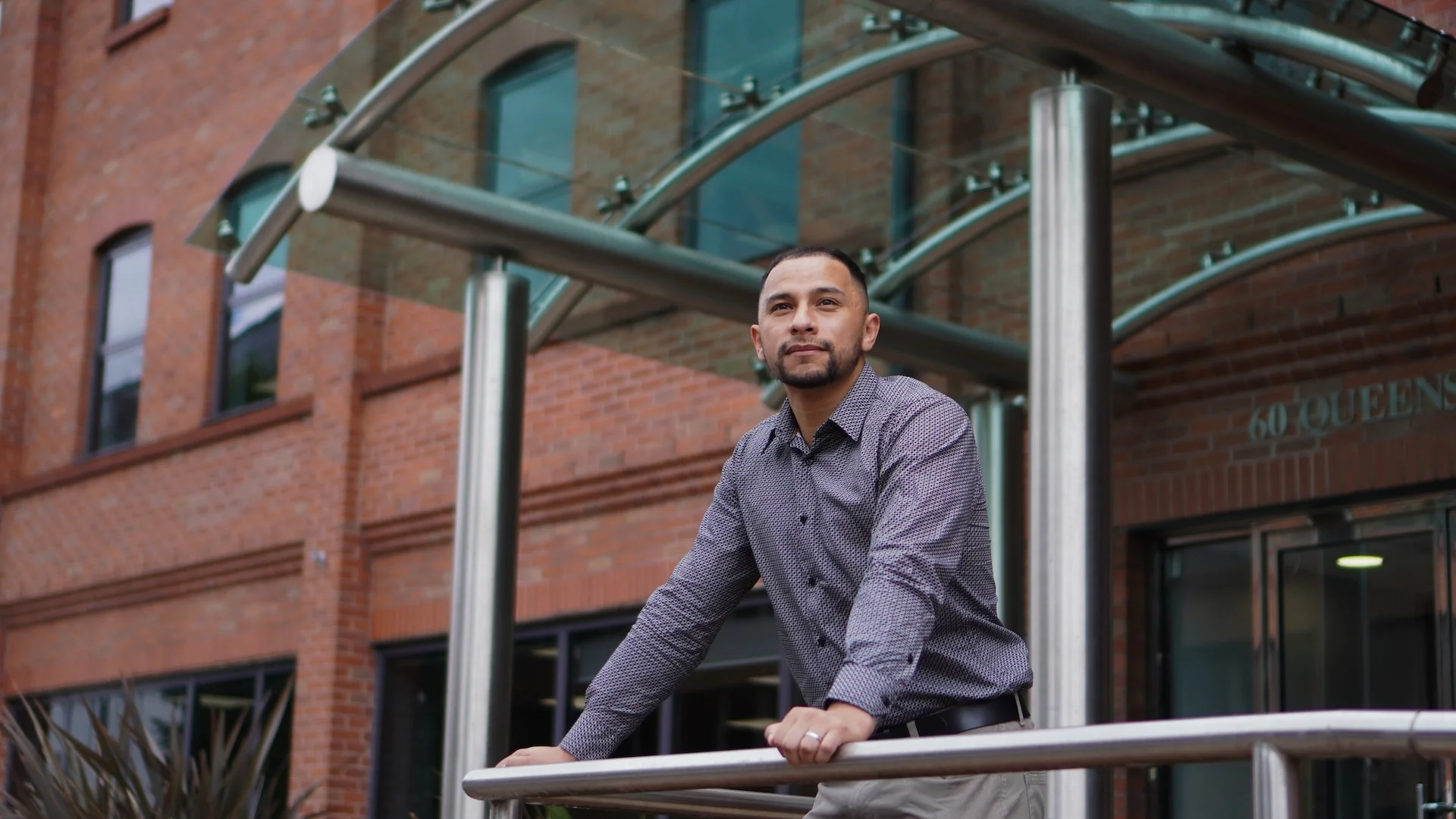
For army veteran Peter Alford, 33, life is anything but ordinary. Amid the full force of family life and a busy career as an assistant project manager at Mace Consult, he has set aside time to pursue a BSc (Hons) degree in Quantity Surveying with the University of the Built Environment.
“Why I wanted to pursue a degree is the same reason why I joined the Parachute Regiment - I wanted to see how far and how hard I could push myself and then what I could achieve at the end of it.”
From Honduras to the Parachute Regiment
Peter’s story begins far from building development sites in the UK as he was born in Honduras, Central America. Moving to England as a child, he grew up in North London before moving to Hertfordshire in his teens. He then joined the British Armed Forces aged 24.
“I spent just over six years in the military,” he said. “Four years with the 3rd Battalion of the Parachute Regiment and then I went on to join a specialist unit for the last two years.”
He added: “The regiment's motto in the Parachute Regiment is ‘ready for anything’. That's rung true in different aspects of my career and different points in time.”
Life after leaving the army

After leaving the British Army, Peter knew he wanted to look for a role in project management. His stepfather, a chartered quantity surveyor, influenced his decision to return to the built environment - a sector he’d worked in before.
Through his stepfather and BuildForce - a network supporting service leavers - Peter was inspired to pursue a career with Mace.
“Whilst I was transitioning out of the army, I saw and looked for people who were already working within Mace who were veterans as well.
“I applied one year and didn’t get in, but I kept trying - approaching them on LinkedIn on a regular basis. ‘Is there any space available? Looking to be an assistant project manager’.
“Eventually I managed to get an interview, and here I am.”
Peter joined Mace Consult as an assistant project manager in 2024, working with clients, surveyors, and design teams on large-scale building projects.
Mace is a proud signatory of the Armed Forces Covenant, which means it is committed to supporting people as they move from military to civilian life. Its pledge includes a bespoke Mace Military Programme - tailored guidance and one-to-one support for service leavers exploring a career with Mace, helping them navigate their next chapter with confidence.
A Mace spokesperson said: “People with an ex-military background have exceptional skills and play a significant role within Mace Consult.
“In providing wide-ranging programme and project delivery services in the built environment in sectors from mobility to commercial property, advanced science facilities, and sports and entertainment venues on the world stage, we are always looking to recruit skilled people and provide them with opportunities to grow.”
Pursuing a degree
Despite his progress at Mace Consult, Peter felt an urge to bolster his academic credentials.
He said: “I have no academic prowess and I kind of wear that badge quite close to my sleeve - I'm quite open about it. I left with Level 1 Maths and borderline English. When I left the army, as I was transitioning, I took on a CMI Level 5 Diploma in Leadership and Management.”
The next step was pursuing a degree, so Peter signed up as a self-funded student for a BSc in Quantity Surveying.
He had noted a number of his Mace colleagues were enrolled at the University of the Built Environment so was inspired to apply to the same institution. Also, his stepfather has a qualification from the University - when it was still known as the College of Estate Management and was affiliated with the University of Reading.
Study, work and family made possible with flexible online learning
With a full-time role at Mace Consult and two children - including a baby - Peter’s days are jam packed, but the University of the Built Environment’s flexible online learning model - the Virtual Learning Environment (VLE) - makes study possible for him.
He said: “I wake up at about five. If my daughter hasn’t woken up already, I’ll study before she does. Then I work from nine, and if I can, I’ll do a bit of reading between meetings. After work it’s straight into bath and bedtime, and if I’m not completely shattered, I’ll study again in the evening.”
For Peter, a key advantage of the University is the various methods of how to learn.
“They run live webinars,” he said, “but if you can’t make them, you can catch up later. You can watch the videos, listen to the audio, or download transcripts. There’s always a way to access the content.
“As you go through the weeks, there's a forum for that specific topic of the week, and the faculty are really good at responding if you don't quite understand something.”
He added: “Sometimes I lose focus, but they have links to videos which for me is great because I'm a bit more of a visual learner. There is a mixture of videos, reading and then the webinars which synthesize that information.
“It's not a one size fits all. There are different ways and different sources that the university has.”
A community spirit online
Studying online via any type of virtual learning platform could potentially feel isolating. However, despite not meeting his fellow students in person, Peter has found camaraderie at the University thanks to forums and WhatsApp groups. For the latter, there are even different group chats for different modules.
Peter said these groups allow students to open up with queries when in a physical classroom they may otherwise “be too embarrassed or nervous to say that they're struggling”.
He said: “Having that community feel where everyone kind of either struggles or celebrates success together – be it with their marks or giving people different pointers - is really handy.”
He added: “It goes to show that not all learning happens in the classroom. It's like the university brings a horse to water but, ultimately, we're the ones who are going to apply the knowledge day to day and have our own interpretation.”

A “quiet confidence”
Now in his third year, Peter reflects on how far he has come.
He said: “Pride doesn’t really enter my head. It’s more of a quiet confidence. Something that I've lived by is, ‘if you chase all rabbits, you catch none’. So put your head down and work hard. It's going to be really hard. It is really hard.”
He added:
"Pride doesn’t really enter my head. It’s more of a quiet confidence. Something that I've lived by is, ‘if you chase all rabbits, you catch none’. So put your head down and work hard."
Discover more stories and case studies from our students, apprentices and alumnus.